
Training Plans vs Training Advice
Training Plans typically have prescribed runs and specific sessions, whilst Training Advice is more general giving pointers on training types, how to structure training and recovery etc. General Training Advice is applicable to a broad range of athletes, whereas a Training Plan is specific to one athlete, or a group of very similar athletes. Search online and you’ll find all sorts of training plans for particular events like London Marathon or Great North Run or standard distances such as 10k, Half Marathon or Marathon. They often claim to be the “right plan for you” or the best way to achieve a particular finish time. But none of them are tailored to you, despite what claims they make or what rudimentary questions you might have to answer before downloading. What is much more useful for athletes is Training Advice, and this is what our coaches can offer club members without the need for too many specifics about the athlete. We are working on some top tips on the benefits of different types of training, how to structure your training and how to achieve the holy grail of performance, enjoyment and staying fit & healthy. Watch out for more on this soon. Of course, as with most subjects you can find lots of training advice online too and again, like most subjects, some of it is great, some of it is complete nonsense. Unsure? Talk to a coach!
Training Plans – Written for someone – probably not you!
People could be forgiven for thinking that a ‘generic’ plan would mean it’s appropriate for a wide range of athletes. However, it’s actually the opposite: It’s a plan written for one specific individual athlete somewhere in the middle of the spectrum of all athletes who might download it… and it’s statistically extremely unlikely that athlete is anything like you. You may be tempted to choose one of these plans thinking it must be pretty good if it’s published by Asics, London Marathon or Runners World. The truth is, it may be a ‘good’ plan (but beware, there are some real shockers out there!) Indeed, many of your coaches will use these plans as inspiration for sessions or training progression when developing a plan for an individual or group of similar athletes with specific goals. However there is a strong chance, it’s not a good plan for you and to follow that plan religiously may result in (best case) you becoming disheartened or (worst case) seriously injured. Either way, it’s unlikely to help you fulfil your goals.
Why? Well there are quite a few variables that make all our members (and indeed all runners) very different: There’s the obvious ones: age, sex, body composition; but then the not so obvious ones: Training Age (the amount of running experience to date), current fitness levels, current training load, knowledge of training methods, likes & disikes, strengths and weaknesses, other sports & activities and availability to train. To illustrate this point: just take 3 variables, plot each member against them and you can see that the likelihood of that specific plan being great for you is slim to say the least.
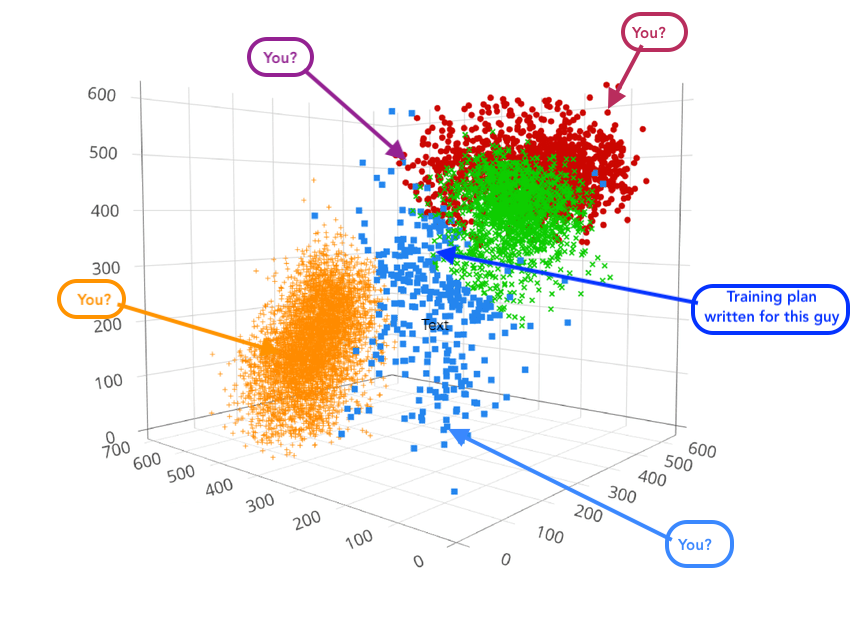
When a generic plan might be appropriate (and when not)
So when can these plans be useful? Well someone who is pretty experienced and has followed plans before may well be able to first sift through several of these generic plans to find one that is an ok fit, then tailor and adapt that plan to be more specific to them, especially if they have had input from coaches before. Even an experienced athlete will certainly benefit from some input from a coach to review that plan or give some input that could make it an even better fit. Runners with less experience are more likely to follow a plan religiously, in the belief that they just need to tough it out and never miss a session. The problem here, is that if that plan is not appropriate for that athlete (and there’s a very good chance it isn’t), this approach will likely do more harm than good. The takeaway here, is if you want to use a plan found online, or write your own… talk to a coach – we can can give some tips on what to avoid in a plan, or even review that plan to help you tailor it to fit your experience, current status and goals.
What if I want more help? Athlete-centric coaching
So what if you want more guidance’s? Well the best answer is to get an experienced, qualified coach (we have quite a few at MAC!) to write a plan specifically for you. The plan and will take into account all of your variables, your goals and targets and produce a plan that is fit for purpose to give you the greatest chance of success. They will then be able to continue to support you as you progress through that plan, adapting as necessary. We call that an athlete-centric approach and it is an in-depth process that most coaches will charge for (although not as much as you might think!) In addition to the more general training advice we’re planning to share, coaches may also be happy to provide the following individual advice – still specific to you but not as in-depth.
- Review a plan that you already have and give some pointers of how to improve it or avoid common pitfalls.
- Provide some ideas and structure to help you create your own training plan.
- Help you get from where you are today, to the starting point of a plan you hope to follow.
Read more here about what coaches can help with.
As always, talk to a coach – we are all volunteers but happy to share our knowledge and experience wherever we can to help athletes
What about AI coaching apps?
There are also a number of apps popping up such as Coopah and Runna which claim to create a personalised plan for you which adapts as you work through it. I’m intrigued by these services and think they could be a good fit for some. However, I’m yet to try them in anger and my knowledge of AI, coaching and the data collected by various wearables, means I’m sceptical as to how good they might be. I plan to review some of them in the coming months so watch out for another blog post on that.